Shed Floor & Walls

Well, we are at the point where I have the floor and walls done.

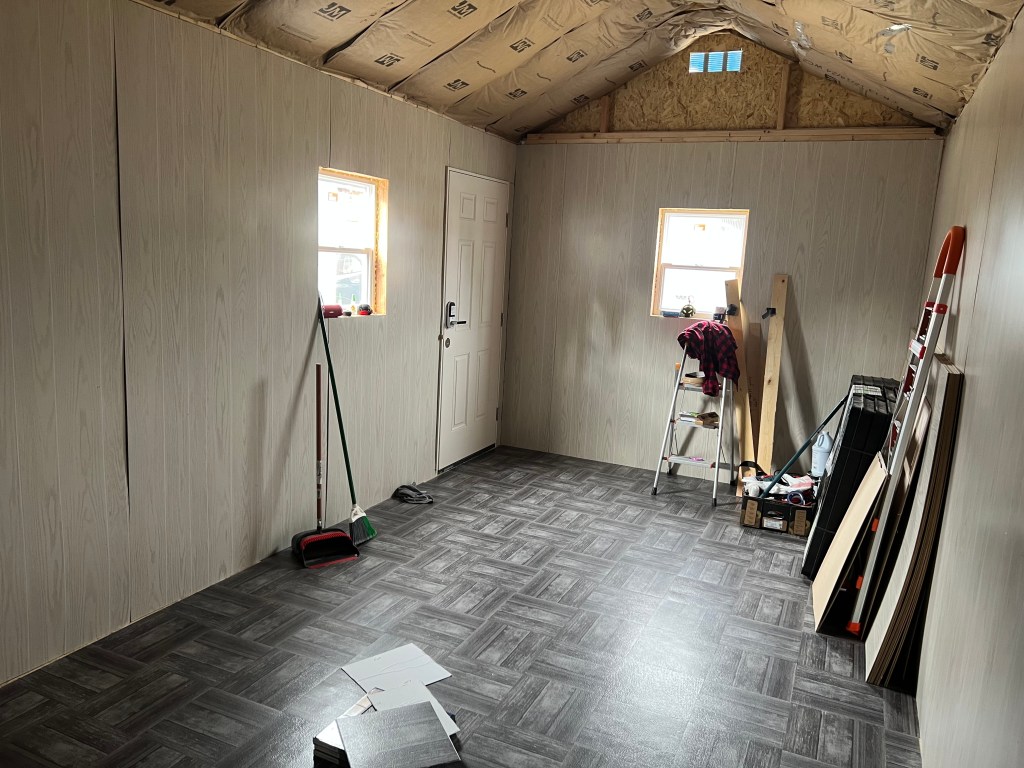
First, the floor is done, primarily. With self stick tiles there is always a chance a few of them will bow and bubble. We’ve had uncharacteristic 90F days, and it did loosen some of them. I will be using a dab of liquid nails to keep them down. That’s worked for me in the past with no issues. I lived for 7 years in a double wide trailer on a floor I put tiles like this down this way, and it looked the same when I moved out as when I put it in.
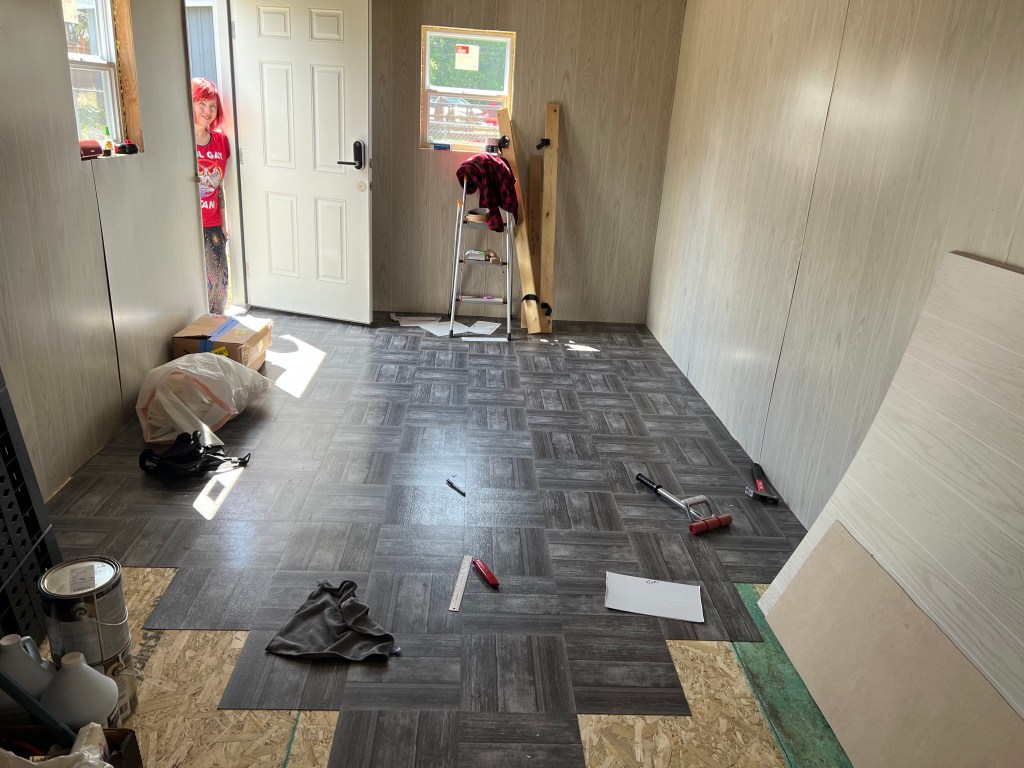
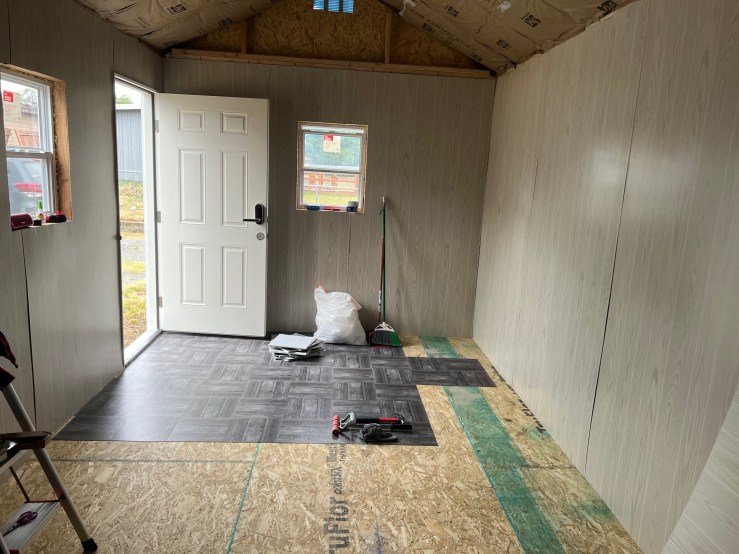
Mid flooring installation with wife.
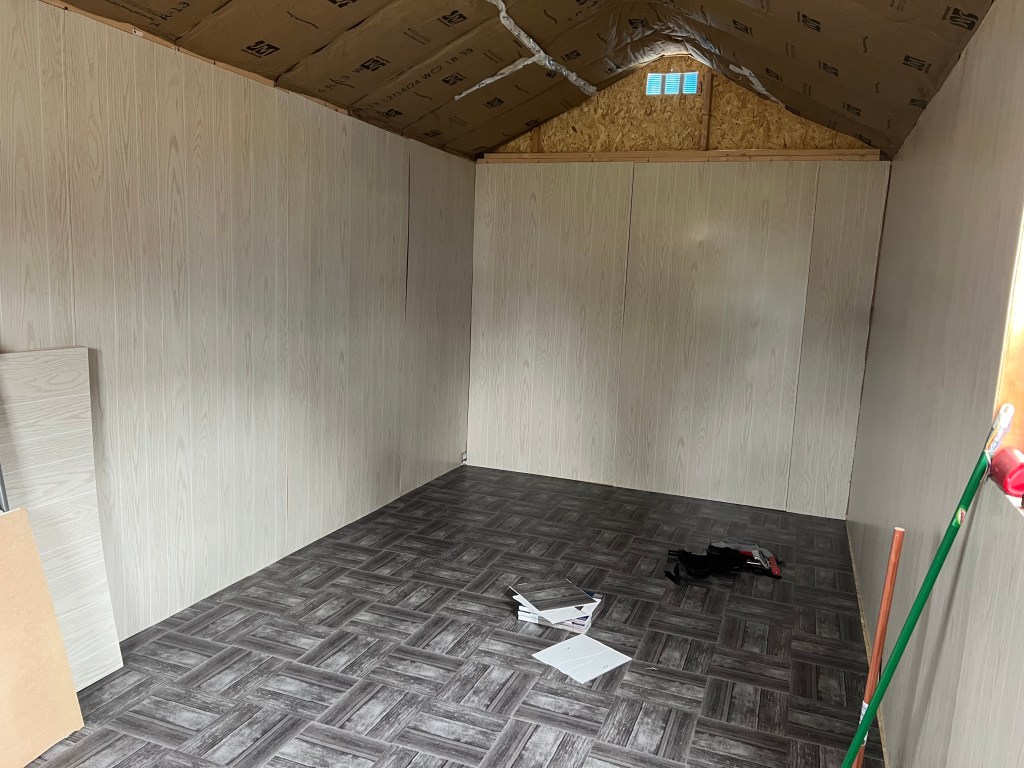
Finished Floor.
Finished back of shed.

Doing a basket weave pattern with the flooring was perfect. It really hid the cheapness of the tiles. Honestly, this was an easy installation. I did have to wear knee pads as my knees can’t take floor work that easy, but I am happy with how it came out.

The walls? That was more frustrating. Apparently you need some H channel to put paneling up, so it slots each side of the touching panels together. The H channel available at Lowes where I bought this paneling, is not for this kind of paneling, but a slightly thinner white bathroom panel. I spent days searching every corner of the internet, and I couldn’t find it. I even tried that H channel with these paneling to see if I could retro fit it between the panels. No dice.

Instead I looked for any surface stick option. I tried stick on molding. It did not stick. I tried stick on edging for MDF shelving. It did not stick. I tried superglue to help any of these options to stick. It did not stick. I used 99% isopropyl alcohol on the seams, but even so, nothing stuck.

At this point I was sure that the surface of the cheap paneling I was using was some sort of secret non stick material that NASA should be notified of. Even epoxy did not stick to it. Literally nothing stuck on the long vertical lines where the two panels met. I tried everything.

After some hair pulling and soul searching, I reminded the inner evil voice of my father that likes to tell me I am screwing up, that this was just a fucking shed, so we were going the full cheap garbage route on this. The only way to fix this the “right” way, was to rip the paneling down, recut it to ensure the edges lined up with the 16 on center studs. However, I don’t own a table saw, and the perfect line up would be impossible and there would still be an issue, likely worse where the two edges me.

Instead, I used the only item that stuck to the paneling. White Gorilla brand duct tape. No other brand of duct tape would stick. I ran a line of duct tape down each join, imperfect as it was, and then a line of duct tape along the base for the cheap stick-it molding to adhere to.
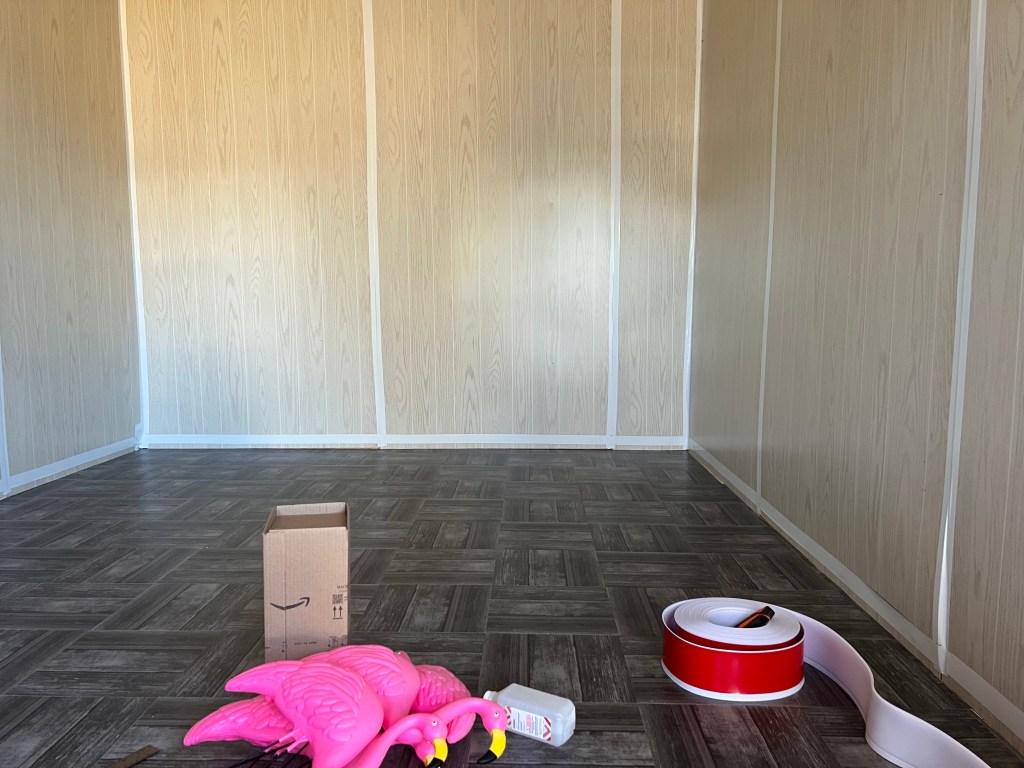
Prepped with duct tape.

This worked. I then added the big white roll of fake molding that you usually see self-stuck in bathrooms and kitchens in cheap rentals.

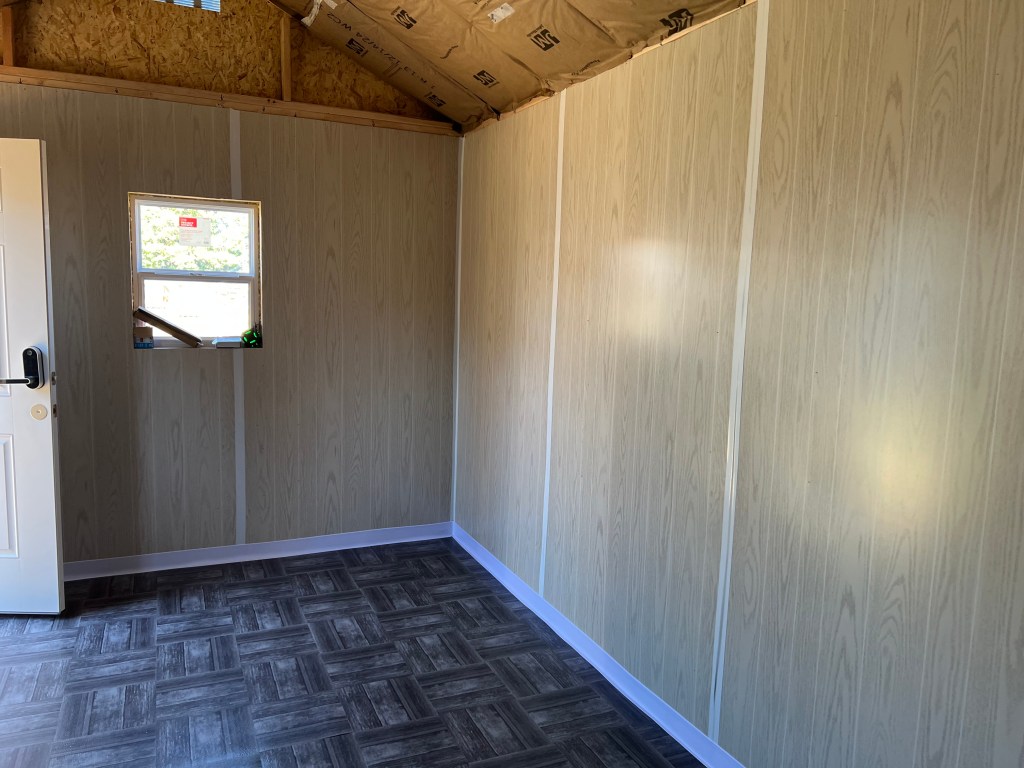
With bottom trim.
With duct tape on wall seams and the bottom trim.

While this is certainly not the right way to do things, it is a way to do it. Once I have the shelves, the circus tent top and the artificial ivy and flowers in there, I think it won’t be as noticeable. What it does do is keep things together and that Gorilla duct tape is literally the only thing on this planet that stuck to the surface of that paneling.

In all honesty, nobody is going to see it but my wife and I, and as a place to put a workout machine, a workout bike, and some storage shelves? It’s okay. I’ll live with it.
Shed Progress

Things have been coming together the last few weeks. My wife and I have kept on moving forward with the shed progress. I wish my garden was doing as well as my shed.

Wall insulation went well.

The wall insulation took us two days. I cut all the insulation to size from the rolls, and put it in and my wife followed me with the staple gun and stapled it in. We had to do it into two days because all the bending and place for a couple of partially disabled people was like doing an endless series of burpees. However, it went in perfectly fine. The insulation is made to fit into a 16 on center bay so it’s not a hard job at all for a DIYer.

What I found shocking was just how much the sound from the freeway we live by was deadened by the insulation. Like damn. It also kept the sun from heating the shed up too much. I am sure it will be appreciated in winter.

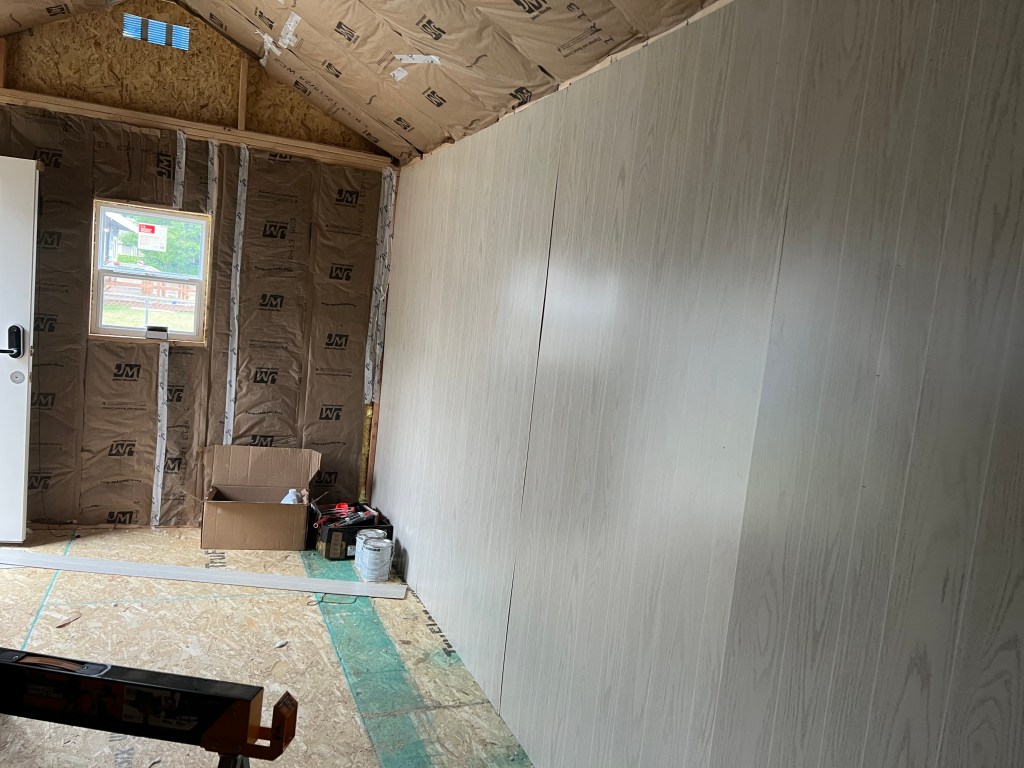
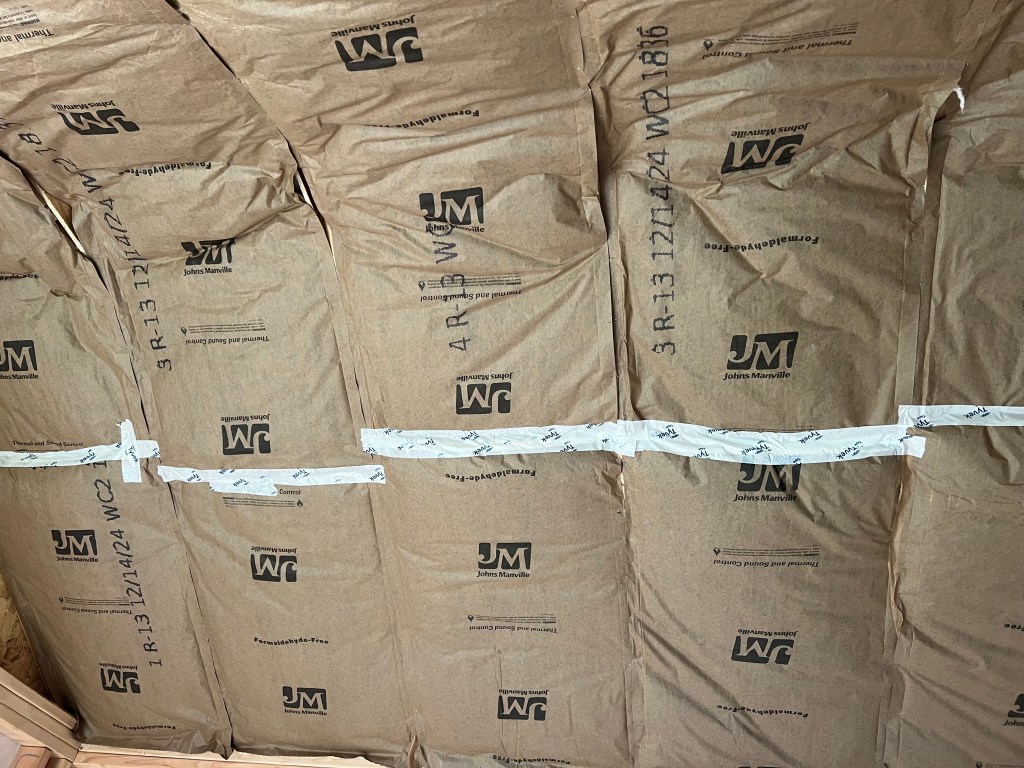
All insulation in.

This is all of the wall insulation in. I used Tyvek tape to tape the seams that didn’t have side insulation flaps, where we cut it thin. I also used the Tyvek tape to cover any holes we accidentally punched in the vapor barrier because we are clumsy.

On to paneling.

I was really sweating the paneling stage. I had never done it before, and I am reflexively nervous about power tools no matter how often I use them.

Turns out it was pretty easy if you have two people, and one of them is over 6 foot tall. I cut the panels to size, and we positioned it in place, and my wife staple gunned the top and I did the bottom.

I had to cut a few inches off each panel because the walls are just a hair below 8 feet tall. I cut the top off one, and used the off cut as a template to cut the rest. These super thin paneling sheets could not support their own weight on the saw horses so I had to cannibalize some of my spare wood bits from the other shed to make it work.

You will notice the seams are visible. I didn’t buy any H channels for the joins, as I didn’t realize I needed them? I had never done this before. I should have, but nope. I did not. I am still working out the joins and will probably use a self sticking 7/8″ edge band if I can get it to work. I am waiting for that to come in.

One thing that really did help was a rotozip tool. I bought a Dewalt rotozip tool (No links here are affiliate links. Just what I used.) and a ten pack of paneling cutting bits. That was amazing. I was able to just put the paneling over the window, and use the rotozip to just cut around the outside. Same for the door. I just put the paneling up, and put the rotozip on the outsize molding of the door, and boom! I was able to just cut it like butter. Highly recommended if you are going to use paneling for anything. Also, get the H channel molding for between panels. Don’t be me.

Starting the floor.

Next step is the flooring. I am just using Floor Pop brand self sticking vinyl tiles. I know these are cheap, but it’s literally just a shed. I used to live in a double wide trailer and we did this across the interior because the 1960s shag carpeting was a disaster and we were poor. They actually did a great job, and held up really well. Better than my current house vinyl floor that is slowly failing, that cost the previous home owner more.

To do this right, I first rolled on a clear coat of pre installation primer adhesive. I was worried the chip board would not be a good surface to stick to. I used Henry Liquid indoor primer. I have never used that before, but you just roll it on. It is white and watery, but dries clear in a couple hours. Very recommended. It didn’t feel sticky or weird, but it kind of sealed the wood and let the vinyl tiles stick very effectively.

I also used DAP Floor patch and leveler after watching a DIY Tiff YouTube video where she uses it on her floor when she redoes it. They are the cutest tiny DIY couple ever. I love watching her progress on her house.

The green boards in the picture above had some big chunks missing from the install that would have made the thin vinyl tiles funky, so filling it worked well. It takes 6 hours to dry, so I started the rest of the flooring and that took all my working ability for the day.

To do these vinyl self stick tiles right, you have to be on top of the dust issue. I swept every few rows, and then kept a dish rag with me, and before I placed a tile, I would sweep it of any possible debris of dust with the dish rag. Then I would really wedge the edges together and kind of roll the tile into place. Then I used a floor roller to really make it adhere. The floor roller is cheap and worth your money. I also kept a hammer to pound down nails that stuck up a bit too much.

Tools and tiles.

I chose to do kind of a basket weave with these stick-it’s because if you run the tiles in the same direction, it doesn’t quite line up, and looks cheaper than if you do it as a basket weave.

I do plan to fix the tall end corner bits on the wall with the vents, but I don’t have any 2×4’s on hand. I’ll just wait on that bit until the second shed is in, and I order supplies for it, so I can pay the Lowe’s deliver fee just a single time. I have to create a 16 on center 2×4 situation up there so I can insulate that as well.

Overall, I feel like this is really starting to come together. I still need a ramp to the door, and to do the gravel around the outside as a boarder, and the panel joins and corner molding bits. However, this is coming to a close and I can see the project’s finish in sight.

Philosophically, this is a different kind of house project from what I am used to. When I was much younger, I’d have had this done in a couple of weeks. I’d have spent 12-16 hour days just plugging along, but now my body doesn’t let me.

That is kind of forcing me to accept my limitations. Like yesterday I started the flooring, and I didn’t feel like I did much, but boy howdy did I feel being on the floor that long. I’ll just keep plugging along and eventually it will be done.

Ceiling Insulation

My first impression of insulating a ceiling is that the damn insulation is so expensive! The R13, 23 inch wide insulation was $126.50 for 11 bats. I had to buy two. That was the most expensive item on my interior list of supplies. By comparison the 15 inch insulation that is 32 feet per roll was only $31.87 per roll. The funniest part was when I was trying to find a source for this, every post I found was of some other person complaining about the price. I guess I am in good company.

The good thing is I only used half the second package so I only have to buy one more for the back yard workshop shed we are planning for last summer.

My second impression is this is more of a two person job. While it likely could be done solo, it’s really hard to get the bat of insulation above you, stuffed between the joists, hope it stays, then try to staple it. That’s a lot.

My wife and I worked together. She is taller and it was easier for her too stand on a step ladder and get it started and feed it to me on my scaffolding. I waffled on buying the scaffolding but for $99 it was worth it. It will come in handy when I fix the house ceilings where the previous owner didn’t use drywall tape and the joins are all cracking.

First bats in.

We were careful not to impeded the soffit vents, or the ridge vent at the top, but just kept it secured to the outside of the joists. We discovered the 8′ bats of insulation got us over the ridge vent area, and down the other side. I have seen YouTube videos of people doing it every which way, so I didn’t think it would be a big deal to just do it the way we did, then patch in a short bit on the other side.

Since we had such issues with the hammer tacker and our weeny arm strength last time, we used an electric staple/nail gun. I got it on sale for half price, and it was the hero tool of the day. (None of these are affiliate links. I just liked the products.)

I thought it would be annoying dealing with a cord, but it was so much faster. My only gripe is it didn’t hold enough staples at one time. I also had to use an electric one as I am not set up for pneumatic tools.

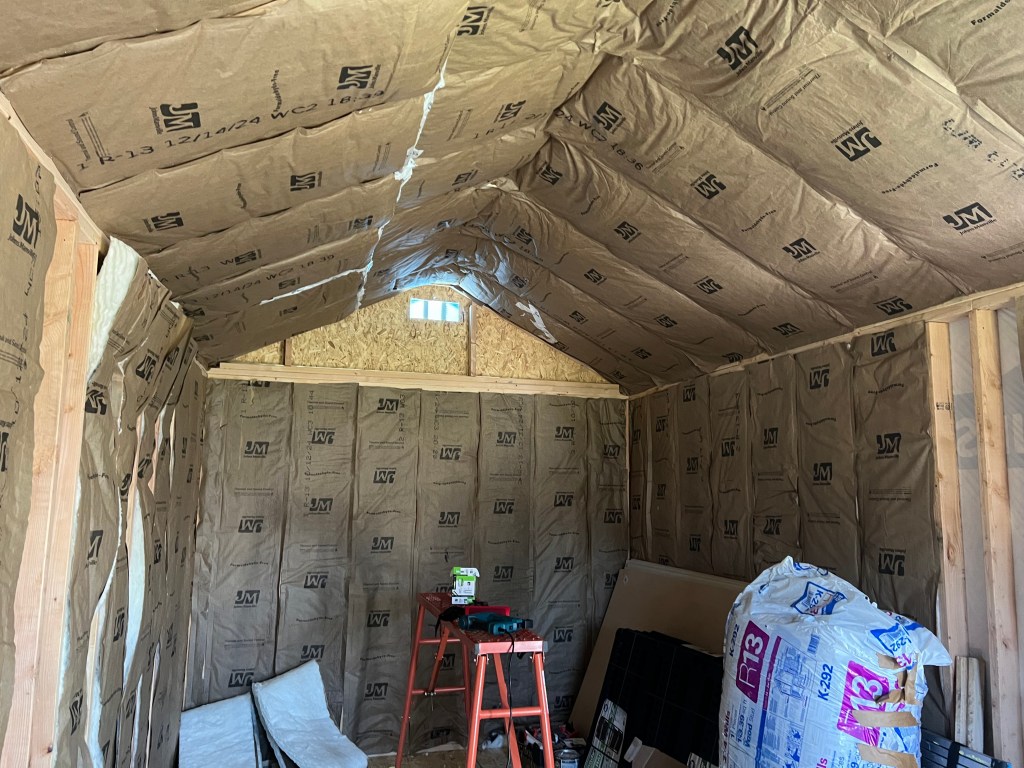
Within two hours we had all the insulation in.

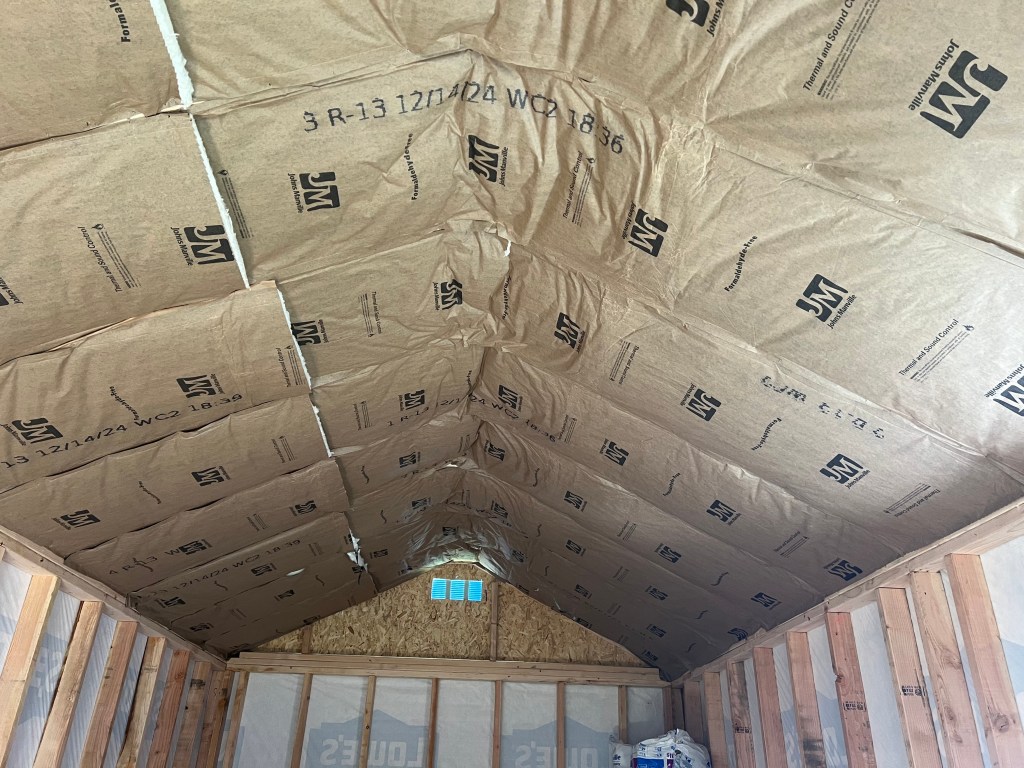
Insulation installed.

That afternoon we noticed immediately that the shed did not heat up as hot from the sun hitting the roof. That’s impressive. Insulation is so worth it.

I did come back and use some tyvek tape to tape the seems on the joined bits of insulation. We overlapped a tiny bit, and I tucked the white fiberglass in, and taped the brown paper to keep our paper barrier intact. I also taped the holes in the paper from delivery. This worked well as I could feel a small breeze in the join, and that killed that problem.

Taped the joins in the bats.

Overall, the ceiling insulation was the hardest bit for us to complete. That is likely due to our own physical limitations. It’s slow going as we can’t do much at a time, but we are getting there.

Next will bet the walls. I don’t know how much we can do in a day, but it will certainly be easier because we don’t have to reach over our heads.

Insulation Baffles

My wife and I started insulating the ceiling of the shed. This was the hardest so far physically for both of us. I am not sure I could have completed it easily if she wasn’t 6’2″ tall with “monkey arms.”

I can only do a few hours of work each week. I mean, if my body was fine, I would do more, but neither my wife or I am in good enough shape that we can do much more. I miss being in my 30s and being able to do a full 8 hours of physical work without being in pain for the next day, and being in bed for the next two.

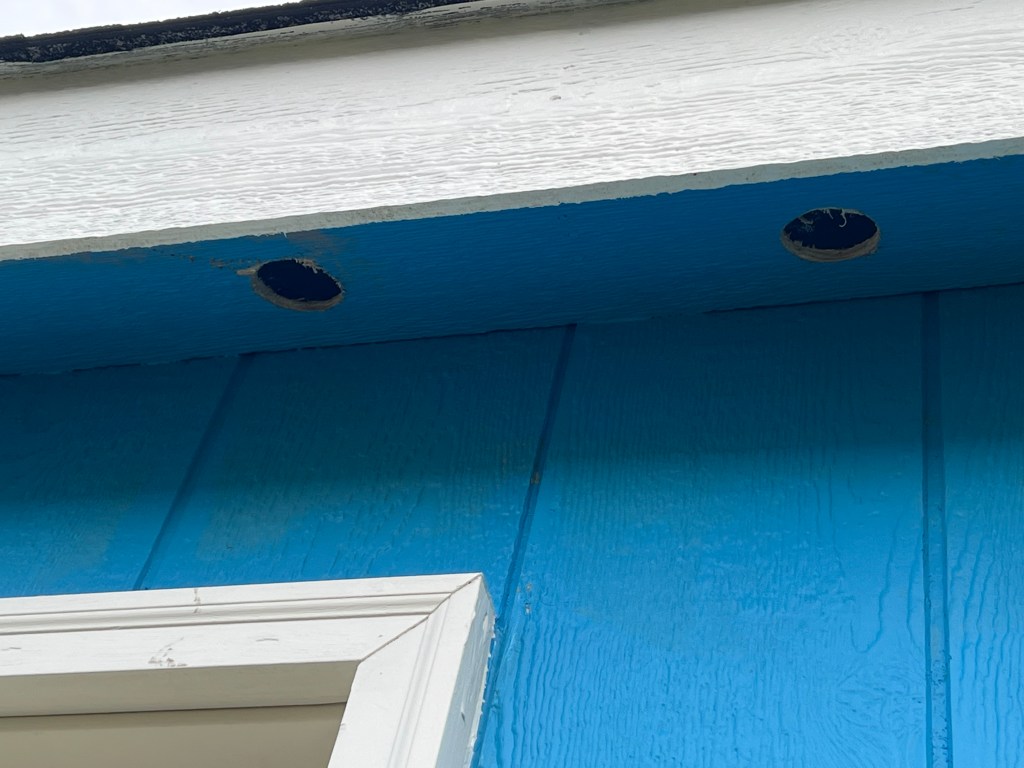
The first order of business was the ceiling baffles. We got the shed option with a ridge vent. There was a bit of a mix up on the types of venting we needed, so we had a ridge vent and a gable vent. I did not realize the gable vent was on the sides of the shed. I will actually close that in because it’s not needed. Instead I used a 2″ hole cutter on my drill and went around and drilled out 2 holes in each bay of the soffit.

Holes in the soffit that I cut for venting.

This was harder on my shoulder and collar bone than I would like. It’s at an angle and I no longer have the physical strength to really power through. It only took me a half hour, but it was physically a lot for me.

I don’t have pictures but I didn’t have any drop in vents for it, but I did have some left over replacement window screen, so I cut that and used some liquid nails to glue them in place. Very cheap, effective, and nobody is gonna see anyways. I will have to touch up the paint around the holes though as I had drill drift on some of them.

We opted for 2×6″ joists to fit the baffles and the insulation. My wife actually had to do the majority of the baffle work because again, I am short and it was just easier for her.

Wife working on the baffles.

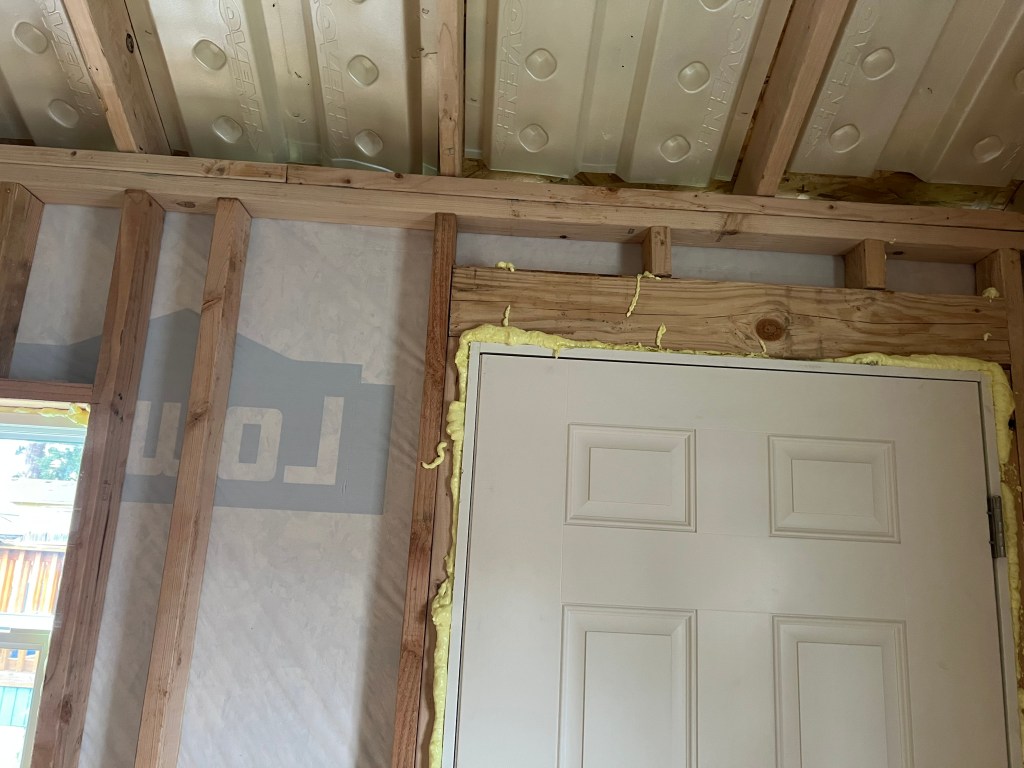
While she did that, I glued the screens in place, added puffy foam around the windows and doors, and generally did everything but put the baffles in. I did not have a handle on the expansion of the insulation “doors and windows” puffy foam, and made a mess. I will have to cut that down later.

Puff foam overextending and making a mess!

As a side note we used a hammer tacker for this. It was the only device I had with staples short enough not to punch through the roof sheathing. It worked all right, but 1) it took a hot minute for me to figure out how to load it, and 2) asking two unfit people to use this device was hilariously hard. It was really hard at an angle, above our heads, to swing with enough force to make it work. I followed my wife with a hammer when needed to sink the stables.

Hammer tacker.

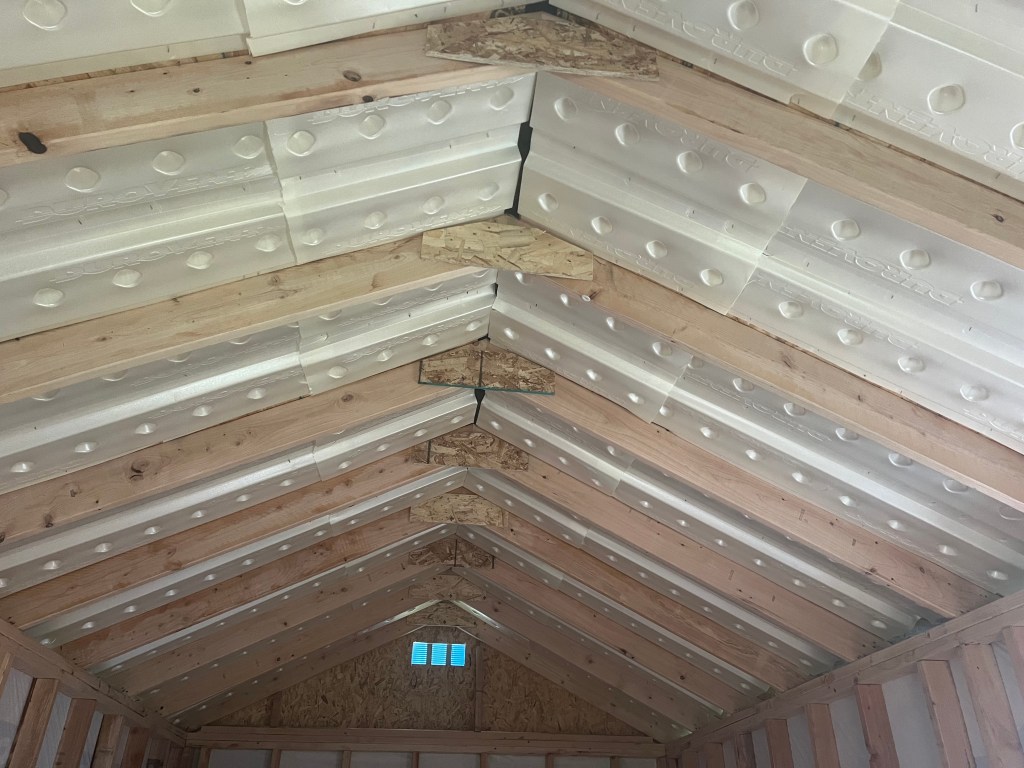
In all, we got it in, and feel really good about it. We were careful to not put the baffles down too low, so that would flow from the soffit vents up along the roof to the sheathing.

Finished baffles!

I think, for two half broken Middle Ages people, we did a pretty good job. I am super proud of my wife, as she doesn’t normally do house fix it stuff, but she did a great job at getting it all in.

Shed Paint

Remember when we got a shed put in our front yard?

We had to paint it within 60 days to make our warranty. We chose a nice blue with white trim.

The first step was caulking, which became a mini whirlwind of disaster for me.

Caulking on seams and nail holes. Remember NOT to caulk under the windows so water can get out.

I bought two paintable silicone caulk tubes off Amazon, and unbeknownst to me, they were old and stiff. It was a new product, so I didn’t know caulk could go off, so I assumed it was just stiff? The problem of being self taught DIY is sometimes you just don’t know what you don’t know.

First, this became an issue as I forced it from the tube, as my wife was not strong enough to do it. That was a mistake physically for my half disabled self. I hurt my right shoulder and bicep so bad! Ouch! It took me days before I could move my right arm right.

Then came the self doubt. We looked it up, and found sometimes caulk that is old like this does not cure. Oh no. . .

The problem when you have a disability is that it’s not just fine, and you can rip it out and do it again. It’s not fine, because you pushed your body to the brink to get it done the first time, you are in pain, and you know another full day of ripping it out will do the same. Then you have to do the same work over again, again in pain. That also means you have to schedule it out farther as your body can only do so much at a time.

Luckily for me, we put off painting for a week to see if the caulk would actually cure, and it did. (My body also was up and running again, so yay!) I left a 1 star review on Amazon, which I never do, and moved on with my life. I had been so freaked out that I had failed.

I blame that caulk for giving me some insights into my anxiety around getting things done, which while was useful in therapy, was not a fun revelation. Also, thanks Dad! Love that your freak outs about house improvements could make an appearance in my psyche at age 53. Love that. . .

Anyways, it turned out okay and the next week we were set to paint.

Roller nap was not thick enough to get into the paneling grooves. Ignore the “grass” as it’s 90% dandelions and won’t exist in the end.

I had bought a thicker roller to try and account for the grooves, but no dice! We had to cut into every groove on the shed. I have a second shed coming in August for the back yard, so I will try to find better rollers by then.

My wife painting panel lines.

My wife and I worked together and it didn’t take terribly long. Longer than my body liked, but in the scheme of things we got it done pretty quick.

Blue paint done, except for touch ups.

I had to wait a week to do the trim because I was sore again.

Trim finished.

I took the opportunity to hit some spots in the stupid panel grooves that didn’t get covered to my satisfaction. The trim took about an hour or so, and when I went out to check, I spent a half hour to put a second coat on. It looks so nice with the trim painted. I mean, I knew it would, but I was still unprepared for how nice, and how happy that would make me.

It’s always amazing to me that it takes so long for the first coat and so much paint, but the second one takes a fraction of the paint and is done in minutes.

My biggest issue is now my house looks really dingy next to the shed. I might have to figure out how to afford getting that painted. It’s likely too expensive for me this year, though.

This was the point where I could really see the shed idea coming together. I still have to insulate and panel the inside, slap down some flooring, and build a ramp, but it’s really working. We will have an exercise space and storage. It’s really happening.

As an aside, the door knob is pretty cool. I got a pin activated one off Amazon. (Not an affiliate, I just liked this one.) I guess to get the supper upscale features I need a hub, but I don’t need those. I am not an AirBnB, just some guy that doesn’t want to worry about his keys when he works out.

I liked it so much I added an identical model to my house’s back door. Very easy to put in, and it worked immediately. This solves the issue from a few months ago where I accidentally locked my wife and I out of the house. I mean, thank god I had my lock picks in my wallet so I could get back in, but having a back door pin will at least mean we can’t ever be locked out. It’s not like we have family or any close friends in town, so being locked out would be an expensive locksmith call.

This weekend, body willing, I am going to try and do the insulation on the ceiling bits.